

Spring’s Coming: Time to Dust Off the Family Fun (and Save Every Memory)

Spring has a way of sneaking up on families. One day you’re still finding mystery mittens in the coat closet, and the next you’re staring down soccer schedules, garden plans, school concerts, and a sudden urge to “do more stuff outside.”

Here’s the good news: spring family activities don’t have to become spring family chaos. With a little prep, you can enjoy the season and capture the moments that tend to disappear into camera rolls, group texts, and “where did we put that video?” confusion.

Step 1: Pick Your Spring “Anchors”

Before you book anything or buy anything, choose a few simple traditions that define spring for your family. Keep it easy and repeatable:

  • A first warm-weather picnic (even if it’s in your backyard)
  • A family walk scavenger hunt (flowers, birds, weird-shaped clouds)
  • A garden day (real garden or just one heroic tomato plant)
  • A “spring cleaning” donate-and-declutter challenge
  • One local adventure: botanical garden, fair, farmer’s market, beach day, hike, parade

The goal isn’t to fill every weekend. It’s to create a handful of moments worth remembering.

Step 2: Give Everyone a Role (Yes, Even the Teen Who “Doesn’t Care”)

Spring activities work better when everyone has a job:

  • Memory Captain: grabs photos and short clips
  • Storyteller: writes a quick recap (even 3 sentences counts)
  • Archivist: uploads and labels content
  • Event Spotter: finds local events and posts options
  • Poll Boss: runs the vote for what you do next weekend

When roles rotate, people participate more—and you don’t become the unpaid family historian every single time.

Step 3: Stop Letting Your Memories Live in Random Places

Spring memories usually end up scattered across:

  • phone galleries,
  • text threads,
  • social media (if you even post),
  • and that one aunt’s Facebook album you can’t access because she forgot her password in 2019.

Instead, store everything where your family can actually find it later—on your private FamilyCrossings family site.

When you upload your spring photos, videos, and stories to FamilyCrossings, you’re doing something bigger than saving files:
you’re building your family’s digital legacy in one secure place, organized the way your family wants it.

Step 4: Create a “Spring 2026” Memory Hub on Your Family Site

Here’s a simple setup that keeps everything clean and easy to browse:

Create a Spring 2026 section and add:

  • Photo albums (picnic, game day, garden, trip, holiday)
  • Short videos (10–30 seconds is perfect)
  • Stories (recaps, funny quotes, “today we learned…” moments)
  • Weekly check-ins (“Best moment this week?”)
  • Polls (vote on next activity, vacation ideas, dinner plans)

By the time summer hits, you’ll have a complete spring timeline—not a pile of forgotten media.

Step 5: Capture the Little Stuff (Because That’s the Good Stuff)

Spring isn’t just “big events.” It’s the small moments you’ll miss later:

  • the first day someone wears shorts and regrets it,
  • muddy shoes,
  • chaotic egg dyeing,
  • a goofy selfie after a win/loss,
  • Grandma’s commentary from the folding chair,
  • the dog stealing a hot dog at the picnic (again).

Those moments are the real family story. Save them.

A Simple Spring Challenge for Your Family

Try this for the next 30 days:

Post one spring memory per week on your FamilyCrossings site.
Just one. Photo, video, or a quick story.

At the end of the season, you’ll have something most families don’t:
a complete “Spring chapter” that everyone can revisit anytime.


Ready to Start?

Log into your FamilyCrossings family site, create a “Spring Activities” Stories area plus a “Spring Pics” Photo folder, and start uploading as you go. The best time to organize family memories isn’t “someday.” It’s while they’re happening.

Because spring flies.
But your family story doesn’t have to.
Smart Lessons in Back-to-School Savings

Get back to school savings at www.familycrossings.com!

Back-to-school shopping is an annual ritual that millions of parents participate in each year. In fact, back-to-school time is one of the biggest shopping seasons of the year, second only to the winter holidays. Last year, Americans spent more than $54 billion on supplies, clothes and electronics for school and college-age kids, according to the National Retail Federation, with jeans, backpacks and electronics as some of the most popular back-to-school products.

Getting what students need and keeping the costs reasonable calls for some smart shopping strategies. The easiest place to start is at your computer. These tips will help you study the online possibilities and earn some A+ deals.

Add Up Extra Savings

Before you start hunting down everything on the must-have list, check for printable coupons or online coupon codes on Web sites such as:

Retailmenot.com: Get helpful feedback from users on what coupon codes worked and which ones didn’t.

Smartsource.com: Entering your zip code lets you find deals specific to your area.

Be on the lookout for free shipping offers on these sites, as well. If you’re not careful, shipping costs can negate any savings you may have found.

Do Your Homework

You might find a great deal on a backpack or computer, but is the cost savings really worth a possible trade off in quality? Find out how products stack up to real world use at sites such as Epinions.com, where users share their product experience. At ConsumerSearch.com, there are expert and user reviews shown side by side for each product. A little research can save you time, hassle and money down the road.

Get the Latest Scoop

If you know exactly what you want to buy, sign up for notifications from Craigslist.com and eBay.com. Both sites will notify you of new listings matching your search criteria – so when someone wants to sell that Juicy Couture jacket you’re looking for, you’ll know right away.

If you need help deciding how to get the best product for your money, look at online buying guides. Not sure which laptop to get? Need help figuring out what kind of backpack or desk chair to get? Check out a mix of user and professional reviews at Bing.com/shopping or read Overstock.com buying guides – there are helpful tips on what to look for and how to make a smart choice.

Another way to stay in the loop on savings is to sign up for retail newsletters and emails. You can also check online retailer sites for RSS feeds that automatically send you updates on promotions as they occur. A well-timed update on a new sale lets you get in on the savings early.

Get Cash Back

A growing trend in smart online shopping is participation in programs that give you cash back. Web sites such as Bing.com have partnerships with major retailers to offer items at great prices. Registered users shop for name brand items and when purchases are made through the site, they automatically get a percentage of the purchase price back as a cash rebate. More details on how this works can be found at bing.com/shopping/pages/howtouse.aspx.

The amounts, which change daily, can be sent via check to your address or deposited into a bank account or PayPal account, and after a 60-day waiting period, the money is yours.

“This is a great way to save money on school supplies,” said Bridget Tate, Bing Shopping product manager. “When you look at how much back-to-school items such as laptops, clothes, backpacks and tech gadgets can cost, that 5 or 10 percent really helps.” During back-to-school season, adds Tate, Bing Shopping will be offering even higher percentages of cash back (up to 50 percent more).

Getting the kids ready for school again doesn’t have to cost a fortune. Smart shopping will send them off in style and leave you with a smile.

To learn more about how to be a smart online shopper and get cash back this back-to-school season, visit Bing.com/shopping.

Shopping That Pays You Back

Shopping with the following merchants through Bing.com could give you savings like these:

Back to School Gear and Gadgets

HP, 5%
OfficeMax.com, 3 to 5%
BarnesandNoble.com, 10%

Back to School Fashion

Shoemall.com, 19%
Sears.com, 2 to 8%
Old Navy, 4%
Ebags.com, 11%
Foot Locker, 20%
Benefit.com, 2%
Beautychoice.com, 10%
Nordstrom.com, 3%

Using FamilyCrossings.com to Grow Your Connections

Imagine if your great, great grandfather or grandmother had left you a book with their secrets for living. Maybe it contained nuggets of wisdom, yummy recipes, favorite jokes, or just insights for how to lead a good life. Ever since people learned of my next book, Life’s Missing Instruction Manual, people are curious how to create their own “manual” for life.

You can leave such a book for your own family. What are the key lessons you’ve learned in your life? Are you ready to share them with your children and grandchildren – or with your friend, siblings, parents, and grandparents?

What you’ve gleaned from your life experiences can make things easier for your children or your relatives. In fact, the lessons you’ve earned from trial and error can be the perfect gift for everyone in your life – or for one person who matters to you. Here’s how to commit your insights to writing and share them with your fellow life travelers.

* Carry a pad of paper around with you everywhere for a week.

* Jot down your thoughts and observations as they occur to you. Don’t judge them. Just make note of them.

* Add personal stories and memories, as they come to mind. Again, don’t edit your thoughts. Just commit them to paper.

* Take a few days to go through your notes, and underline the most important passages, and make additional comments in the margins.

* From this, distill the lessons you most want to share with others: your perspective, your values, what matters most to you, and your reactions to the world around you.

* Find a beautiful journal or blank book – one that you feel a strong connection with. You might find it at a bookstore, an antique store, an online auction site, a craft store, or even a flea market. Where you find it doesn’t matter. How you feel about it does.

* Fill the journal with your own instruction manual for life. Make sure to include a title and your name.

* Find a special person to share it with, and turn the presentation of the journal into a celebration.

If you don’t feel comfortable writing your notes and stories, you can dictate them into a portable tape recorder, and later, you can transcribe them into a journal. You don’t have to be a bestselling author, academic, or philosopher to create a instruction manual that can helped your loved ones every day of their lives… and be passed on to future generations as well.

Family History

Family Histories are made out of stories and tales about people, places, and events related to the members of immediate family members and our ancestors. Family stories casually chatted about at the dinner table, or related at family gatherings can provide great insights into a family’s hostory. The memorable stories of our lives and of others in our family take on special importance because they are true, even if everyone tells different versions of the same event. Stories like these are family heirlooms held online and in the mind forever heart.

Taking an Interview

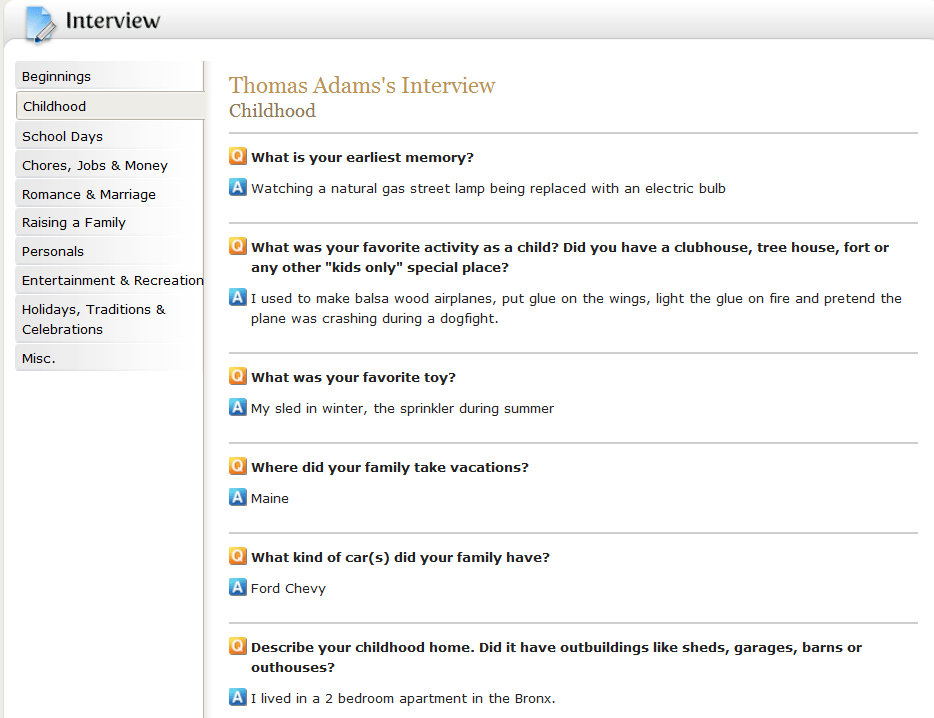
FamilyCrossings have a preset interview process where each family member can contribute stories about their lives to share with other family members.
Birth Information, Childhood, School Experiences, Jobs, Romance and Marriage, Raising a Family, Personal Accomplishments, Entertainment and Hobbies, Holiday Traditions
history

Getting Started with Family History

The first step to collecting family stories is to become a good listener. Good listeners encourage great storytelling. When a speaker feels that the listener is interested, he or she is more inspired to communicate generously. A good listener gives full attention to the teller, does not interrupt or contradict the facts of a story as it is being told, and offers the teller encouragement with an interested facial expression and body stance. When a teller feels encouraged by an interested listener, there is joy in the telling. Let everyone know that they can include that fabulous story in FamilyCrossings.com

Interviewing Elders

An effective way to hear family stories is to ask questions. Family stories can be collected by interviewing a family elder. Make a mental or written list of topics that might generate some interest from other family members to ask the elder.

Questions about:

People, places, events, objects, important transitions, work, or travel can be story starters. Although short-term memory may sometimes be limited in the oldest of relatives, long-term memory may be very much intact. We need to help the teller journey back in time to retrieve these treasures.

Add Your Story

Start the Interview process right now! Take a moment to add your own history! Lead by example.